
Why Is PAYE Tax Important in Nigeria?
Oluwatomisin Adeyemi · Nov 26, 2026 · 7 min read
On this page
PAYE tax in Nigeria affects both employees and the businesses that pay them. It is the process through which income tax is deducted from employment earnings and sent to the relevant tax authority.
When payroll teams calculate it correctly, employees can understand what has been deducted, and employers can meet their tax responsibilities. When they get it wrong, the business may face extra costs, employees may question their payslips, and tax records can become difficult to reconcile.
This article explains why PAYE is important to employees, employers and government, how the 2026 tax bands work, and what both sides should check to keep tax records and payments in order.
What is PAYE Tax?
PAYE means Pay As You Earn. Rather than requiring every employee to calculate and pay employment income tax on their own each month, the employer calculates the applicable amount, deducts it from pay and remits it to the relevant tax authority.
PAYE relates to taxable employment income. Depending on the circumstances, this may include salary, wages, bonuses, commissions, allowances and certain benefits provided by an employer. Not every payment is treated in exactly the same way, so payroll should follow the current tax rules when determining what counts as taxable income.
PAYE is a collection method for personal income tax. It is not a separate tax added on top of personal income tax, and it is not the same as pension contributions or other payroll items. Each item needs to be identified and calculated under its own rules.
Why is PAYE important in Nigeria?
1. It helps employees keep track of their tax obligations
A payslip that clearly shows PAYE gives an employee a record of the tax deducted from their earnings for that pay period. Employees can compare the deduction with their gross pay, check whether their personal details are correct and ask payroll to explain a change that they do not understand.
This is especially important when an employee changes jobs, receives a bonus, gets a salary increase or has a change in their taxable benefits. Any of these changes may affect the calculation. Employees should keep their payslips and tax documents rather than rely only on the amount that reaches their bank account.
2. It helps employers meet their legal responsibilities
Employers do not simply calculate PAYE and move on. They must identify the right tax authority, calculate the amount correctly, deduct it, remit it within the required period and submit the relevant returns. The Nigeria Tax Administration Act 2025 sets out employer filing duties, including the annual return for employee emoluments.
The current law states that PAYE is due on or before the 10th day of the month following the month in which salaries were paid, and that employers must file an annual return of employee emoluments by 31 January for the preceding year. Employers should confirm current filing instructions with the relevant revenue authority.
Money deducted from employees but not remitted is not a small administrative oversight. It creates a compliance problem and can expose the employer to penalties, interest or disputes. Payroll records should show both the amount deducted and evidence of payment to the authority.
3. It gives government a steady source of revenue
PAYE provides the government with a regular source of personal income tax revenue because employers deduct and remit tax as employees earn their salaries. This helps the relevant tax authorities collect revenue throughout the year instead of relying only on payments made at a later date. The revenue collected contributes to government spending and the public services it is responsible for providing. Accurate deductions and timely remittance help keep this process reliable.
How is PAYE Calculated in Nigeria in 2026?
Nigeria’s tax framework changed on 1 January 2026, when the Nigeria Tax Act 2025 took effect. Employers should not continue using an old PAYE spreadsheet without checking whether its rates and assumptions remain current.
Below is the annual personal income tax bands under the new framework:
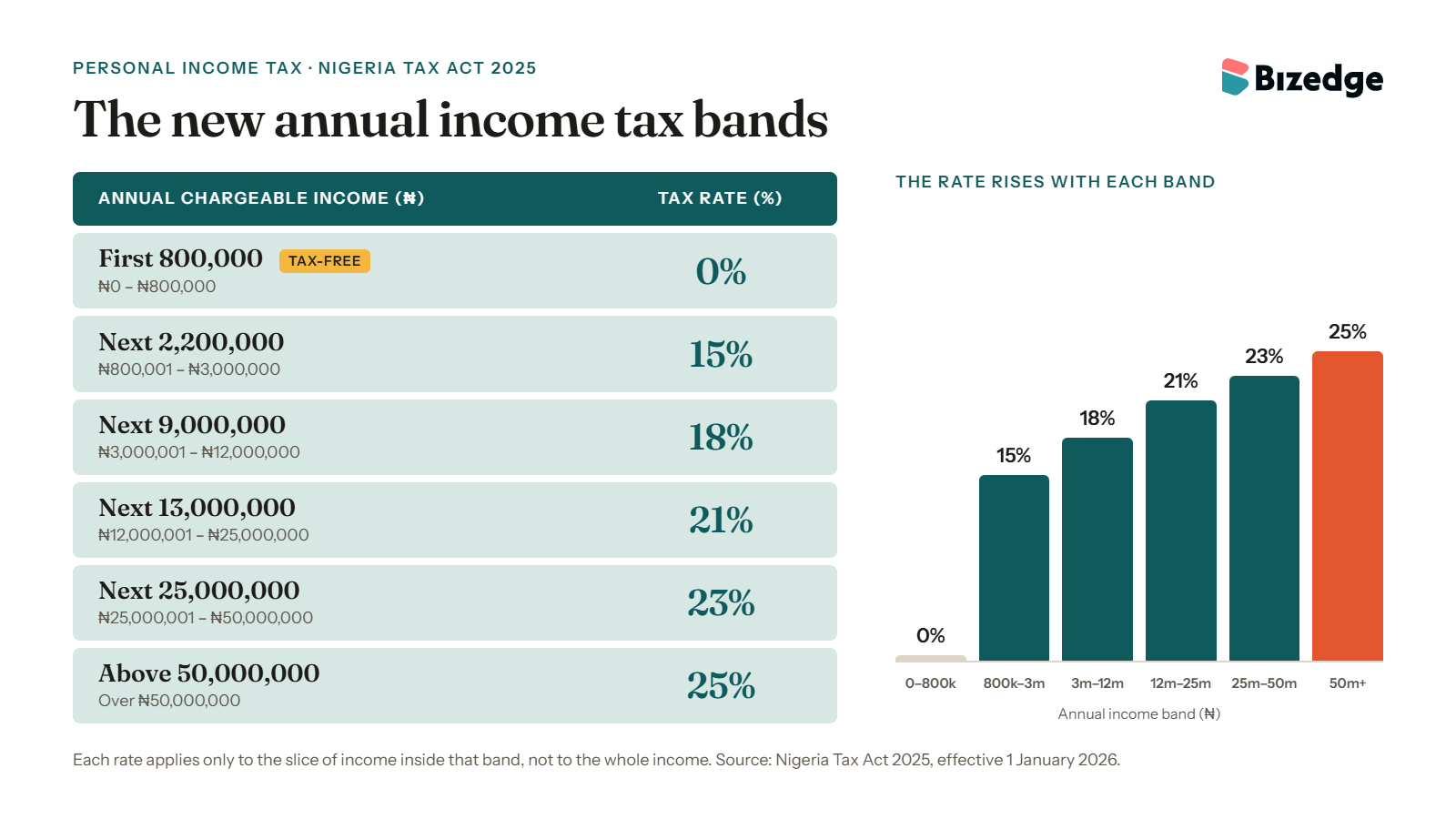
These rates are progressive. That means each rate applies to the portion of chargeable income within its band, not to the employee’s entire income. An employee with annual chargeable income of ₦3 million, for instance, would not simply pay 15% on all ₦3 million. The first ₦800,000 falls in the zero-rate band, while the next ₦2.2 million falls in the 15% band.
The calculation must also take account of the current rules on taxable income, eligible deductions and reliefs. The 2025 Act includes a rent relief for eligible taxpayers, equal to 20% of annual rent paid, capped at ₦500,000, subject to the law’s conditions and required declaration. Payroll should not grant a relief automatically without confirming eligibility and supporting information.
Because the tax rules have changed, the safest approach is to use an updated payroll calculation and have a qualified tax professional or the relevant authority check unusual cases, including benefits in kind, irregular bonuses or changes in employment during the year.
What are the Employer’s PAYE Responsibilities?
A reliable process should cover more than the calculation itself. Employers should:
Register with the appropriate revenue authority and confirm which authority is responsible for the employee’s personal income tax.
Keep accurate records of salary, allowances, bonuses, taxable benefits and relevant employee information.
Calculate PAYE using the rules in force for the period being processed.
Show the deduction clearly on the payslip.
Remit the tax by the prescribed deadline and keep the receipt or other proof of payment.
File the required monthly or annual schedules and returns in the format requested by the authority.
Correct errors promptly and keep a record of adjustments made.
Businesses with employees in different states, employees who join or leave partway through a tax year, and employees who receive non-periodic payments should confirm the correct treatment rather than apply one assumption to everyone.
What Should Employees Check on Their Payslips?
1. Start by checking that the gross earnings shown on the payslip match the agreed salary and any approved changes.
2. Look at the PAYE line and compare it with previous months. A change may be correct if earnings, benefits or tax details changed, but payroll should be able to explain it.
3. Check that your name and other relevant details are correct, and keep payslips, employment letters and any tax documents you receive. If the employer deducts PAYE, ask how to obtain confirmation of the tax remitted where that information is available.
If the calculation seems wrong, raise it with HR in writing. State the pay period, the amount you believe needs checking and the reason. A clear request makes it easier for the payroll team to investigate.
Common PAYE Mistakes Employers Should Avoid
Common problems include using outdated tax bands, treating the highest applicable rate as a flat rate on all earnings, omitting taxable bonuses or benefits, applying a relief without the required evidence, remitting after the deadline and failing to reconcile deducted tax with payment records.
Another mistake is treating employer contributions as employee deductions. A payroll report should separate what is withheld from an employee’s earnings from the additional costs the employer must pay.
A monthly review can catch many of these problems. Compare the current payroll with the previous period, investigate unexpected changes and ensure the amount deducted matches the amount remitted. Where rules are unclear, ask the relevant revenue authority or a qualified tax adviser rather than guessing.
BizEdge helps businesses organise payroll calculations and review employee earnings and deductions before approving a pay run. Keeping salary details and deduction records together makes it easier for HR and finance teams to review each payroll period.
Frequently Asked Questions About PAYE in Nigeria
1. Is PAYE the same as personal income tax?
PAYE is the method used to collect personal income tax from employment earnings. It is not a separate tax from personal income tax. BizEdge helps businesses organise payroll calculations and review employee earnings and deductions before approving a pay run.
2. When should an employer remit PAYE?
Nigeria’s tax guidance states that PAYE should be remitted by the 10th day of the following month. Employers should confirm the deadline and filing process with their relevant tax authority.
3. Do all employees pay the same PAYE rate?
No. The current system uses progressive annual tax bands, and the amount payable depends on chargeable income and applicable reliefs. Employees should not assume that a colleague’s deduction should be identical to theirs.
4. What should I do if my PAYE deduction looks wrong?
Ask HR for a breakdown and check your payslip against your earnings and relevant tax details. Keep the response and any corrected payslip for your records.
Comments
Leave a comment
Related posts

How to Set Up Payroll for a New Nigerian Business
Keep your business registration documents, tax identification details and business bank account information ready
Oct 16, 2026 · 6 min read
Read More
How to Calculate Employee Turnover Rate: A Comprehensive Guide
Employee turnover rate shows the proportion of employees who leave an organisation during a specific period compared with the average number of employees during that period. An employee may leave voluntarily by resigning, or the employer may initiate the separation through dismissal, redundancy or another form of involuntary exit.
Sep 3, 2026 · 4 min read
Read More
How Many Jobs Will AI Replace by 2030?
Many market research analysts say that AI has the potential to bring about numerous positive changes in society, including enhanced productivity, improved healthcare, and increased access to education. Others, particularly those in roles built around repetitive manual work, see it differently. To them, AI and robotics are less a productivity story and more a threat to job security. As new AI tools roll out and coverage of them grows, that divide is only likely to widen.
Aug 31, 2026 · 6 min read
Read More