
L&D: What Is Learning and Development in the Workplace?

How the New Nigeria Tax Act 2025 Eases the Burden on SMEs in Nigeria

Payroll automation helps businesses shift focus from routine tasks to supporting growth and employee well-being.
From tracking hours and calculating wages to verifying deductions and processing payments, manual payroll management can quickly consume valuable time and even minor errors risk compliance issues or employee dissatisfaction.
Modern HR and business management software like BizEdge automates these processes, ensuring accuracy and efficiency. This not only saves time and reduces mistakes but also enhances transparency, allowing HR and finance teams to prioritize strategic initiatives over repetitive tasks.
This guide explains, in detail, how payroll automation works, the key steps to implement it, and the benefits it can bring to your organization.
1. Select a Comprehensive Payroll Automation System
The foundation of payroll automation lies in choosing a robust, flexible payroll software solution. A strong system does much more than calculate salaries, it manages compliance, integrates with other essential tools, and ensures accuracy across every pay cycle.
An ideal payroll system should offer a wide range of features, including automated wage calculations, built-in tax rules that update automatically, direct deposit capabilities, and customizable reporting options. It should also integrate seamlessly with your HR and accounting systems so that information flows smoothly across the organization without manual transfers. This ensures consistency and reduces the risk of data entry errors.
Employee self-service portals are another critical component. These allow employees to access payslips, update personal information, download tax forms, and review payment histories without placing additional administrative burdens on HR teams. Ultimately, selecting the right software creates a solid foundation that supports every other aspect of payroll automation.
2. Centralize and Digitize Employee Information
To fully automate payroll, all employee information must be complete, accurate, and digitized in one central system. When employee data is scattered across spreadsheets, emails, or paper files, payroll processing becomes slow, inconsistent, and prone to errors. Digitization eliminates these complications by ensuring that everything needed for accurate payroll calculations is stored in one place.
This includes personal details, job titles, employment contracts, salary structures, tax details, pension contributions, allowances, shift differentials, and more. Having this data standardized and stored in your payroll system allows the software to automatically apply the correct rules and calculations for each employee every pay cycle.
Digitization is also essential for handling workforce changes. When employees receive promotions, salary adjustments, or new benefits, updating this information in one central system ensures that changes are immediately reflected in payroll processing. This eliminates the need for repeated manual edits and prevents miscalculations or compliance issues.
3. Automate Time and Attendance Tracking
Manual time tracking is not only tedious but also one of the biggest sources of payroll inaccuracies. Employees may forget to record hours, supervisors may struggle to verify them, and manual entry creates opportunities for mistakes or discrepancies.
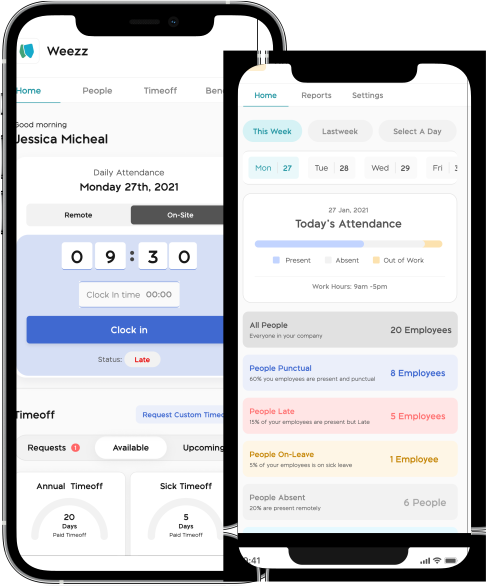
By integrating an automated time and attendance system, your organization gains accurate, real-time information about hours worked. Tools such as biometric systems, mobile apps, digital punch clocks, or cloud-based attendance platforms automatically record each clock-in and clock-out. These systems can also capture overtime hours, break durations, shift differentials, and leave balances with precision.
Once integrated with your payroll software, all this data flows directly into payroll calculations. This ensures that employees are paid correctly and on time without manual verification. Automating attendance not only reduces errors but also strengthens transparency, minimizes disputes, and guarantees that employees are compensated fairly for the time they worked.
4. Configure Recurring and Rule-Based Payroll Settings
A major advantage of payroll automation is the ability to set rules that the system follows consistently across each payroll cycle. This step involves configuring recurring payroll schedules, salary structures, tax deductions, pension contributions, allowances, bonuses, and any other compensation-related policies.
For example, you can set the payroll system to automatically calculate and apply tax deductions based on current laws, process employee contributions to benefits, or trigger automatic payments for recurring allowances. These rules ensure that your payroll operates smoothly without requiring manual recalculations or adjustments every month.
Once configured, your payroll system can run automatically on a weekly, bi-weekly, or monthly basis. This eliminates repetitive tasks and reduces the need for human intervention, aside from occasional approval checks. It creates a reliable, predictable payroll workflow that operates efficiently regardless of workforce size.
5. Automate Payslips, Notifications & Record-Keeping
Another major advantage of payroll automation is the generation and distribution of digital payslips. Instead of printing and manually distributing documents, the system automatically generates payslips and sends them to each employee through email or the self-service portal.
Automated record-keeping is equally important. Payroll software can store all pay runs, tax filings, employee payment histories, and compliance documents in secure cloud storage. These records are accessible for audits, financial reviews, or year-end reporting without having to search through physical files or multiple folders.
This improves accuracy, eliminates paperwork, strengthens compliance, and gives employees easy access to the information they need, reducing the volume of HR inquiries related to pay, taxes, or benefits.
6. Integrate Payroll with Accounting and HR Systems
When your payroll system operates in isolation, you still face manual work, such as entering payroll numbers into your accounting books or updating employee changes manually in HR systems. Integrating payroll with your broader digital ecosystem solves this problem.
When payroll, HR, and accounting systems are connected:
- Labor expenses are automatically recorded in your general ledger
- Financial reporting becomes more accurate
- Budget forecasting becomes easier and more reliable
- HR updates instantly reflect in payroll settings
- Administrative teams spend far less time duplicating work
This unified approach ensures consistent, error-free data throughout your organization, creating a more efficient digital workflow.
7. Use Payroll Analytics for Better Decision-Making
Payroll automation is not just about efficiency, it also provides access to valuable data that can inform strategic decision-making. Modern payroll systems come with built-in analytics tools that track key metrics such as labor costs, overtime spending, absenteeism patterns, compliance risks, and workforce cost distribution.
These insights enable HR and finance leaders to identify trends, optimize staffing levels, manage budgets more effectively, and anticipate future labor costs. Detailed reporting is especially valuable during audits, performance reviews, or strategic planning sessions. By turning payroll data into actionable insights, organizations gain a deeper understanding of workforce dynamics and financial health.
8. Conduct Routine Reviews to Maintain Accuracy
Even after you completely automate payroll, periodic reviews are necessary to ensure accuracy and compliance. Employee roles change, salary increases occur, benefits are added, and tax regulations evolve. Conducting monthly or quarterly audits helps identify discrepancies early and keeps your payroll system aligned with real-life changes.
During these reviews, organizations typically assess tax updates, leave balances, timesheet anomalies, benefit contributions, and any adjustments to employment structures. Staying proactive with system maintenance ensures that payroll automation continues to operate smoothly and accurately, protecting your business from compliance issues or financial errors.
Choosing to automate payroll with software solutions is a transformational step for any business. By digitizing employee data, integrating time-tracking tools, linking payroll with accounting systems, and leveraging advanced analytics, companies can save hours every month while improving accuracy and compliance. Payroll automation allows HR and finance teams to shift their focus from repetitive administrative work to more strategic initiatives that support growth, employee satisfaction, and organizational performance.