
Best Applicant Tracking Software for SMEs in Nigeria

What You Should Know About People Management: Definition & Importance
How to Choose an HR System: 5 Factors to Consider
How to Choose an HR System: 5 Factors to Consider

Table of Content
Artificial Intelligence is no longer regarded as a distant or futuristic concept within human resources, rather, it has increasingly been embedded into everyday HR operations and decision-making processes.
Across organizations of varying sizes, AI technologies are being utilized to reshape how employees are recruited, managed, developed, and retained. Functions that were once heavily manual, such as payroll processing, performance tracking, and workforce planning, are now being automated and enhanced through intelligent systems.
As a result, AI-powered HR systems are being recognized not merely as optional tools, but as essential components of modern organizational.
Despite these advantages, the adoption of an AI-powered HR system is not without its challenges. When an unsuitable solution is implemented, unintended consequences may arise. Issues such as poor user experience, lack of system integration, limited functionality, and non-compliance with regulatory requirements can hinder operations rather than improve them.
In many cases, fragmented processes may persist, administrative workloads may increase, and employee engagement with the system may decline. Consequently, the expected gains in efficiency and productivity may not be fully realized.
For this reason, careful evaluation is required before any AI-powered HR system is introduced. Several critical considerations need to be assessed to ensure that the selected solution aligns with organizational needs, supports long-term growth, and delivers measurable outcomes.
Factors such as usability, scalability, integration capabilities, insight generation, and compliance support should be thoroughly examined during the decision-making process.
Factors to Consider Before Adopting an HR System
By carefully considering these five factors, a more informed decision can be made when adopting an AI-powered HR system. When these elements are properly addressed, the system is more likely to enhance efficiency, support employees effectively, and contribute to improved business performance.
1. Integration of All HR Functions into a Single Platform
Why It Should Be Considered
It is essential that all core HR functions, such as payroll, recruitment, performance management, attendance tracking, and employee records, are integrated into a single, unified platform. When systems are interconnected, data is allowed to flow seamlessly across different HR processes, reducing the need for manual input and minimizing inconsistencies. A centralized system also ensures that HR teams are provided with a holistic view of employee data, which supports better coordination and decision-making.
What Is Likely to Happen If Not Considered
If integration is not prioritized, multiple disconnected tools may be adopted. As a result, data silos are likely to be created, duplication of work may occur, and errors may become more frequent. HR teams may be required to switch between platforms, leading to inefficiencies and reduced productivity. Ultimately, visibility across the employee lifecycle may be limited, making it more difficult to manage people effectively.
2. Ease of Use for Employees and HR Teams
Why It Should Be Considered
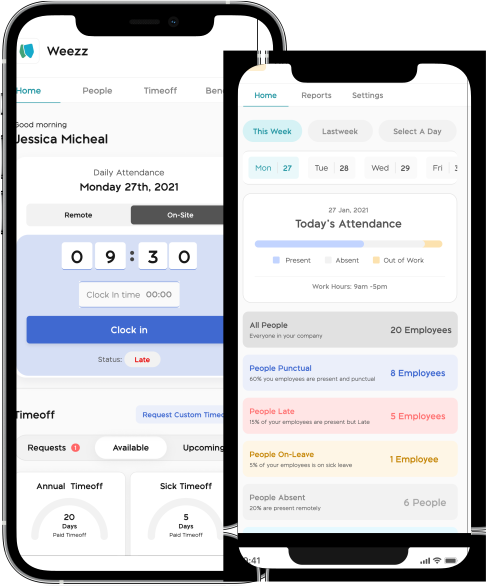
The usability of an AI-powered HR system plays a critical role in its success. A system that is intuitive and easy to navigate is more likely to be adopted by both employees and HR personnel. Features such as self-service access, mobile compatibility, and a clear interface ensure that everyday tasks, such as requesting leave or accessing payslips, can be completed without difficulty.
What Is Likely to Happen If Not Considered
When ease of use is overlooked, employees may struggle to interact with the system, leading to low adoption rates. HR teams may then be forced to revert to manual processes to support employees, which defeats the purpose of automation. Over time, frustration may build, errors may increase, and the overall efficiency of HR operations may decline.
3. Ability to Generate Actionable Insights
Why It Should Be Considered
An AI-powered HR system should not only automate tasks but also provide meaningful, data-driven insights. Through analytics and reporting, patterns in employee performance, engagement, and turnover can be identified. These insights enable informed decision-making and allow organizations to address issues proactively rather than reactively.
What Is Likely to Happen If Not Considered
If actionable insights are not generated, the system may function merely as a data storage tool rather than a strategic asset. Large volumes of data may be collected without being translated into useful information. Consequently, opportunities to improve performance, reduce attrition, or optimize workforce planning may be missed.
4. Scalability
Why It Should Be Considered
As organizations grow, their HR needs evolve. It is important that the selected system is capable of scaling alongside the business. This includes accommodating an increasing number of employees, supporting multiple locations, and offering additional features as requirements expand. A scalable system ensures that long-term needs are met without disruption.
What Is Likely to Happen If Not Considered
If scalability is not taken into account, the system may become inadequate as the organization grows. Limitations in capacity or functionality may arise, requiring a transition to a new system. Such transitions can be costly, time-consuming, and disruptive to ongoing operations, often leading to data migration challenges and temporary inefficiencies.
5. Compliance with Local Regulations
Why It Should Be Considered
Compliance with local labor laws, tax regulations, and data protection standards is a fundamental requirement for any HR system. An AI-powered solution should be designed to align with the legal framework within which the organization operates. Automated updates and compliance features help ensure that regulatory requirements are consistently met.
What Is Likely to Happen If Not Considered
Failure to consider compliance can expose organizations to significant risks. Errors in payroll, tax calculations, or statutory reporting may occur, potentially resulting in financial penalties or legal consequences. In addition, reputational damage may arise if employees’ rights or data privacy are compromised. Ensuring compliance is therefore critical to maintaining operational integrity and trust.
When Should an AI-Powered HR System Be Adopted?
The adoption of an AI-powered HR system should be considered when certain operational signs begin to emerge within an organization. It is not merely the size of the company that determines readiness, but the level of complexity, inefficiency, and growth being experienced.
In many cases, adoption becomes necessary when HR processes are increasingly being handled manually and are no longer sustainable. Tasks such as payroll processing, leave management, and employee record-keeping may begin to consume excessive time and resources, leaving little room for strategic HR activities. When errors become frequent and turnaround times are delayed, it is often an indication that existing systems are no longer sufficient.
Adoption should also be considered when there is limited visibility into workforce data. If decisions are being made without clear insights into employee performance, engagement, or turnover trends, the absence of a data-driven system may be hindering business growth. At this stage, an AI-powered solution can provide the structure and intelligence required for better decision-making.
Additionally, as organizations begin to scale, whether through increased hiring, expansion into new locations, or the management of remote teams, the need for a more robust and centralized HR system becomes more apparent. Without a scalable solution in place, operational inefficiencies are likely to increase, and consistency across HR processes may be difficult to maintain.
Compliance requirements may also signal the need for adoption. As regulatory frameworks evolve, manually keeping up with tax laws, statutory deductions, and labor policies can become both complex and risky. An AI-powered HR system can help ensure that compliance is maintained consistently and accurately.
Ultimately, an AI-powered HR system should be adopted at the point where manual processes begin to limit efficiency, visibility is reduced, compliance risks increase, and business growth demands a more structured approach. When implemented at the right time, such a system is more likely to deliver long-term value, improve employee experience, and support sustainable organizational success.
Looking for a smarter way to manage HR processes?