
How to Deal With a Bad Organisational Experience

How to Successfully Convert a Contractor to a Full-Time Employee Using an Employer of Record (EOR)

In every workplace, performance is often measured by results, deadlines met, targets achieved, and projects completed successfully. But behind many performance issues is a simple, overlooked problem: unclear tasks. When employees don’t fully understand what they’re supposed to do, how to do it, or when it should be done, productivity begins to drop and frustration rises.
Clarity is not just a management preference, it’s a performance driver. When tasks are clearly defined, teams move faster, make fewer mistakes, and feel more confident in their work. When they are not, performance inevitably suffers.
The Link Between Task Clarity and Performance
Task clarity plays a critical role in determining how effectively employees perform in their roles. It refers to how well individuals understand their responsibilities, expectations, and expected deliverables within a given timeframe. True clarity goes beyond assigning work; it involves communicating the purpose of the task, outlining the required steps, setting realistic deadlines, and defining what success should look like. When employees have a complete picture of what is required, they can align their efforts with organizational goals and execute tasks with confidence.
In contrast, when tasks are vague or poorly communicated, performance begins to decline. Employees may spend valuable time trying to interpret instructions, seeking repeated clarification, or making assumptions about what is required. This uncertainty slows down execution and often leads to duplicated efforts, overlooked details, and outcomes that fall short of expectations. Instead of focusing on productivity and innovation, employees become preoccupied with figuring out what they are supposed to do. Over time, this creates delays, inefficiencies, and frustration within teams.
A lack of clarity also affects motivation and engagement. When employees consistently receive unclear instructions, they may feel set up for failure, leading to reduced confidence in their abilities and a decline in overall morale. Even highly skilled and experienced professionals struggle to perform at their best when expectations are not clearly defined.
Clear communication, therefore, serves as the backbone of high-performing teams. When tasks are properly defined and communicated, employees can prioritize effectively, make informed decisions, and deliver results that meet or exceed expectations. Clarity fosters accountability, minimizes errors, and ensures that everyone is working toward the same objectives. In an environment where tasks are clearly outlined and understood, teams operate more efficiently, collaboration improves, and overall performance is significantly strengthened.
Reasons Why Performance Suffers When Tasks Are Not Clear
1. It slows down execution and productivity
When tasks are not clearly defined, execution naturally becomes slower. Employees who are unsure of what is expected cannot move with confidence or speed. Instead of starting immediately, they pause to interpret instructions, seek clarification, or make assumptions about the desired outcome. This hesitation interrupts workflow and reduces efficiency across teams.
Time that should be spent on productive work is often redirected toward figuring out the task itself. Employees may go back and forth with managers or colleagues to confirm details such as priorities, deadlines, or expected results. In some cases, they may begin a task with incomplete understanding and later discover they need to restart or change direction. These interruptions create delays that build up over time and reduce overall output.
Unclear tasks also make prioritization difficult. When employees do not fully understand the urgency or importance of a task, they struggle to decide what to focus on first. As a result, critical assignments may be delayed while less important ones are completed. Clear direction enables employees to manage their time effectively and maintain strong productivity, while unclear direction slows everything down.
2. It increases errors and repeated rework
A lack of task clarity often leads to mistakes. When employees are not fully aware of what is required, they rely on assumptions to complete their tasks. Even when they put in their best effort, the final result may not meet expectations because important details were not clearly communicated.
These mistakes result in corrections and rework, which consume additional time and energy. Instead of moving forward with new tasks, employees must revisit work they believed was already completed. This not only delays progress but also creates frustration for both employees and managers. Repeated revisions can make employees feel unproductive and overwhelmed, even when the issue stems from unclear instructions rather than poor performance.
Reducing errors starts with clarity. When employees know exactly what is expected, they are more likely to deliver accurate results the first time, improving efficiency and performance across the organization.
3. It weakens accountability and ownership
Clear tasks establish responsibility, while unclear tasks create confusion about who is accountable. When roles and expectations are not properly communicated, employees may be unsure about who should handle specific duties. This can lead to tasks being ignored, delayed, or completed by multiple people unnecessarily.
Without clear ownership, accountability becomes difficult to maintain. When something goes wrong, it is harder to identify where the breakdown occurred. This can create tension within teams and reduce trust in leadership. Employees may also feel less motivated to take initiative if they are uncertain about their responsibilities.
When tasks are clearly assigned, employees understand what they are responsible for and are more likely to take ownership of outcomes. Strong accountability improves reliability, efficiency, and overall performance.
4. It reduces employee confidence and motivation
Employees perform best when they have a clear understanding of what is expected of them. When tasks are vague or inconsistent, uncertainty begins to affect confidence. Employees may worry about making mistakes or delivering work that does not meet expectations, leading to hesitation and self-doubt.
Over time, this uncertainty can reduce motivation. Employees who constantly operate without clarity may begin to disengage from their work. They may avoid taking initiative or contributing ideas because they are unsure of the direction they should follow. This lack of confidence directly affects productivity and overall performance.
Clear instructions and expectations create a sense of stability. When employees understand what success looks like, they can approach their work with confidence and a stronger sense of purpose.
5. It disrupts teamwork and alignment
In many workplaces, tasks involve collaboration across teams or departments. When instructions are unclear, each person may interpret the task differently. This leads to inconsistencies in execution and misalignment between teams. One department’s misunderstanding can affect another’s output, creating delays and confusion throughout the workflow.
Misalignment often results in additional meetings, corrections, and adjustments that could have been avoided with clear communication from the beginning. Instead of focusing on achieving shared goals, teams spend time resolving misunderstandings.
Clear tasks keep everyone aligned. When employees understand the objective, their role, and the expected outcome, collaboration becomes smoother and more effective. Strong alignment improves efficiency and helps teams deliver better results.
6. It makes performance difficult to measure and improve
Performance can only be properly evaluated when expectations are clearly defined. If employees are unsure about what success looks like, it becomes difficult for them to assess their own progress or for managers to measure results accurately. Unclear tasks create gaps in performance tracking and make improvement harder to achieve.
Without clarity, feedback may also become inconsistent or ineffective. Employees cannot improve on expectations they do not fully understand. This slows professional growth and prevents organizations from optimizing performance.
Clear, well-communicated tasks provide measurable standards. They allow employees to track their progress, understand feedback, and continuously improve. When expectations are defined from the start, performance becomes easier to manage, evaluate, and strengthen.
How to Improve Task Clarity to Boost Performance
1. Start every task with a clear objective
Performance drops when employees don’t understand the purpose of a task. Managers should clearly explain the task’s goal, its importance to broader organizational objectives, and what a successful outcome looks like. Understanding the “why” helps employees focus and deliver better results.
2. Define specific expectations and deliverables
Vague instructions lead to mistakes, rework, and reduced performance. Employees should know exactly what is required, the format, quality standards, and supporting materials. Clear expectations ensure employees spend more time executing and less time guessing.
3. Set realistic timelines and deadlines
Performance suffers when employees are unsure of deadlines or face unrealistic timeframes. Setting clear, achievable deadlines allows team members to plan their work effectively, stay organized, and maintain consistent productivity.
4. Provide written instructions and resources
Verbal instructions can easily be forgotten or misinterpreted. Written guidelines, checklists, templates, or reference documents give employees a reliable resource to consult, reducing mistakes and keeping performance on track.
5. Use examples to illustrate expected result
This reduces guesswork, minimizes errors, and ensures employees can meet quality standards efficiently.
6. Encourage questions and early clarification
Employees perform better when they feel comfortable asking questions. Addressing uncertainties before work begins prevents mistakes and ensures tasks are completed correctly the first time.
7. Schedule regular check-ins for performance tracking
Brief progress updates allow managers to catch misunderstandings early, provide guidance, and ensure alignment with expectations. Regular check-ins prevent confusion from impacting performance.
8. Clarify roles and responsibilities
Performance suffers when employees are unsure who is responsible for what. Clearly assigning ownership ensures accountability, reduces duplicated efforts, and keeps projects moving smoothly.
9. Link tasks to organizational objectives
Employees are more motivated and perform better when they understand how their work contributes to larger goals. Showing the connection between tasks and business outcomes encourages ownership and drives better results.
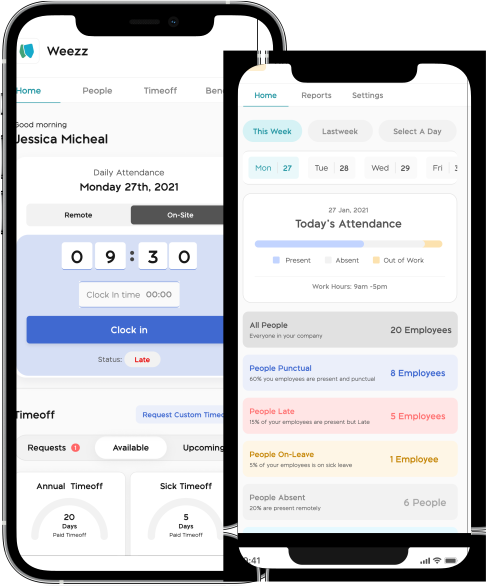
10. Use smarter tools like BizEdge to support clarity and performance
The right tools make a big difference. Platforms like BizEdge can help managers assign tasks clearly, track progress, and provide a central space for instructions, deadlines, and feedback. Using smarter tools reduces confusion, keeps teams aligned, and ensures employees perform at their best.