
What Your Employees Need to Know About Professional Development
How Many Jobs Will AI Replace by 2030?
How Many Jobs Will AI Replace by 2030?

Table of Contents
Many market research analysts say that AI has the potential to bring about numerous positive changes in society, including enhanced productivity, improved healthcare, and increased access to education.
Others, particularly those in roles built around repetitive manual work, see it differently. To them, AI and robotics are less a productivity story and more a threat to job security. As new AI tools roll out and coverage of them grows, that divide is only likely to widen.
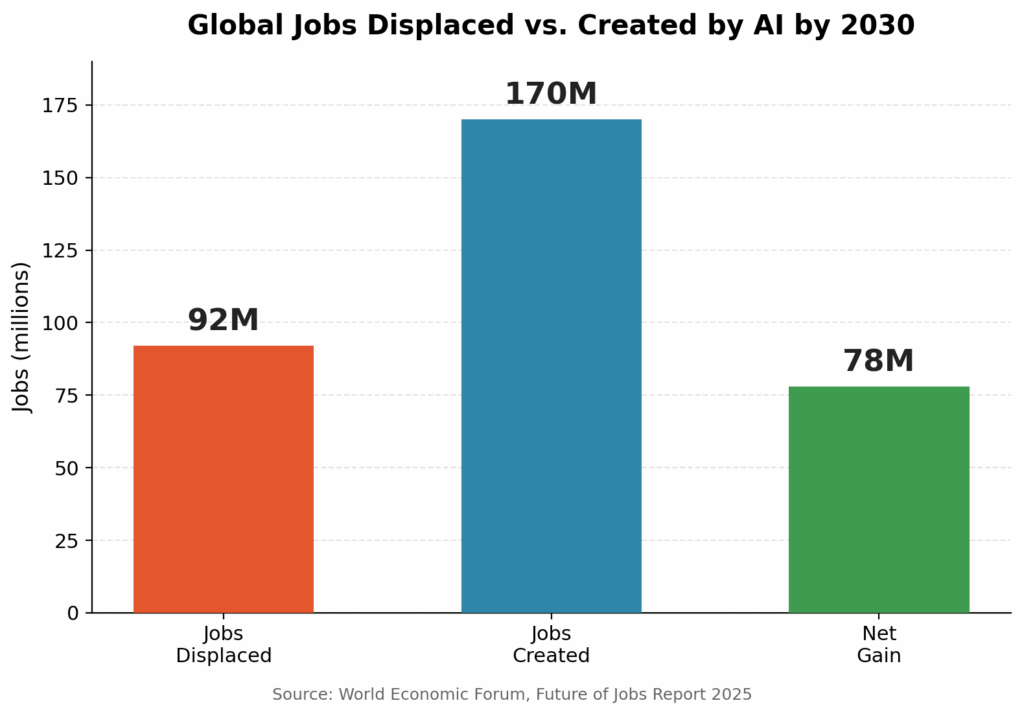
In most mainstream estimates, a similar range is landed on: roughly 85 to 92 million jobs are projected to be displaced globally by 2030, an outcome that is expected to be offset by a larger number of new roles being created.
The World Economic Forum’s Future of Jobs Report projects that about 92 million existing positions worldwide will be eliminated by automation and AI, while around 170 million new ones will be generated, a net gain of roughly 78 million jobs.
Using estimates from Goldman Sachs, total job exposure is put as high as 300 million worldwide, and even higher figures are reached in some generative-AI-specific projections, when full-time-equivalent task displacement is counted rather than outright job loss.
It is far more likely that the majority of jobs will be transformed by AI than that they will be eliminated outright.
Jobs Considered Most at Risk
- Data entry and administrative support: Work that is routine, digitized, and easily handled end-to-end by AI.
- Customer service representatives: A large share of routine queries is now managed by chatbots and AI voice agents.
- Bank tellers and back-office banking roles: A continued decline is projected, as digital banking expands.
- Cashiers and basic retail roles: Headcount continues to be cut by self-checkout and automated retail systems.
- Translators and interpreters: Counted among the highest-risk occupations, given how far machine translation has advanced.
- Manufacturing and assembly-line workers: Headcount in factories continues to be reduced by robotics and AI-driven quality control.
- Paralegals and legal research support : Document review and first-pass legal research are increasingly capable of being automated.
- Medical transcription and coding: A large share of this work has already been automated by speech-to-text and AI documentation tools.
Jobs That Are Considered More Resistant
Far greater insulation is found in roles that require physical presence, accountability, emotional judgment, negotiation, or complex real-world decision-making. Among these are:
- Skilled trades (electricians, plumbers, HVAC technicians)
- Healthcare roles involving hands-on patient care
- Teaching and early-childhood education
- Senior management and strategic leadership
- Jobs requiring legal or regulatory accountability
- Creative direction and complex problem-solving roles
Even in these fields, the way work gets done is being changed by AI, but full replacement is considered far less likely in the near term.
Jobs Expected to Be Created by AI
In the World Economic Forum’s modeling, more jobs are shown to be created than lost by 2030, with concentration seen in:
- AI and machine learning specialists, data analysts, and big data engineers
- Renewable energy and sustainability roles, as the green transition is accelerated alongside AI adoption
- Cybersecurity and information security roles
- Care economy jobs like, nursing, elder care, and other human-centered services
- Roles that did not exist five years ago, such as AI trainers, prompt engineers, and AI governance specialists
The buildout of data center and power infrastructure needed to support AI has been specifically pointed to by Goldman Sachs as a major source of new employment over the coming years.
What the Numbers Look Like for Nigeria and Africa
Most of the headline figures in the World Economic Forum’s Future of Jobs Report are based on global or U.S. data. However, Nigeria’s situation differs from both in some important ways.
On exposure to AI, Nigeria generally faces a lower risk than advanced economies. The IMF’s global assessment estimates AI exposure at around 26% across low income economies, a category that includes much of Sub Saharan Africa. In comparison, exposure stands at roughly 60% in the U.S., UK, and other advanced economies.
This difference is largely due to the structure of the Nigerian economy. A much larger share of Nigeria’s workforce works in agriculture and the informal sector. These jobs are generally harder to automate than office based roles that rely heavily on computers and digital tools.
However, slower AI adoption in Nigeria does not necessarily mean less disruption. Instead, it is likely to mean that the disruption happens more gradually. Nigeria’s public service is also particularly vulnerable because it is the country’s largest single employer and many of its roles involve routine, repetitive, paper based, or process driven work.
At the same time, the African Development Bank and other regional analyses have raised a related concern. The bigger issue may not be jobs disappearing altogether, but the economy failing to create new jobs quickly enough.
Youth unemployment across Africa already stands above 12%. At the same time, education systems are not developing the digital skills needed for AI related roles quickly enough to keep up with the pace of change.
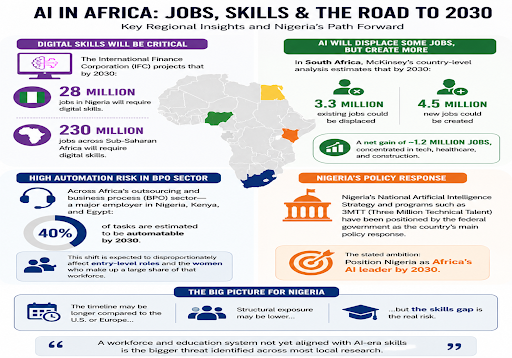
- The International Finance Corporation projects that by 2030, around 28 million jobs in Nigeria and 230 million across Sub-Saharan Africa will require digital skills.
- In South Africa, McKinsey’s country-level analysis estimates that machine learning, AI, and advanced robotics could displace 3.3 million existing jobs by 2030, while creating around 4.5 million new ones, a net gain of roughly 1.2 million jobs, concentrated in tech, healthcare, and construction.
- Across Africa’s outsourcing and business process (BPO) sector, a major employer in Nigeria, Kenya, and Egypt, up to 40% of tasks are estimated to be automatable by 2030, a shift expected to disproportionately affect entry-level roles and the women who make up a large share of that workforce.
- Nigeria’s National Artificial Intelligence Strategy and programs such as 3MTT (Three Million Technical Talent) have been positioned by the federal government as the country’s main policy response, with the stated ambition of positioning Nigeria as Africa’s AI leader by 2030.
The picture for Nigeria looks less like “AI will replace fewer jobs here” and more like “the timeline is longer, but the skills gap is the real risk.”
Structural exposure may be lower than in the U.S. or Europe, but a workforce and education system not yet aligned with AI-era skills is the bigger threat identified across most local research.
What This Should Mean for a Career
Better outcomes tend to be experienced by workers who learn to use AI tools than by those who do not. In several studies, a meaningful wage premium is shown to be earned by professionals with AI skills over peers without them.
Reskilling into AI-adjacent, judgment-heavy, or human-centered work is consistently identified as the most effective way for displacement risk to be stayed ahead of.
Looking for a smarter way to manage your HR processes? Book a demo